
Casino · Live · Sports
Wageon Betting in the United Kingdom: Odds, Bet Types and Payments
Wageon betting in 2026: sportsbook markets, live betting, odds and bet types for UK punters.

Wageon sportsbook markets and odds
Boxing
Tennis
Esports
Handball
Football
Formula 1
Wageon: welcome bonus for new players
- fast payouts
- mobile-friendly
- quick registration
Wageon offers for new UK accounts
Wageon in short answers
How do I verify my account?
- You upload an ID document in your profile once.
What is the minimum deposit?
- The amount is listed for each payment method.
Is the site legal?
- The operator works under a licence and checks players' age.
I walk through Wageon for players in 2026: how the sportsbook works, which markets it covers, the UK Gambling Commission licensing context and paying by Visa. Gambling is for adults aged 18+ and carries a risk of loss.
How to Place Your First Bet at Wageon: The Shortest Path From Account to Bet Slip
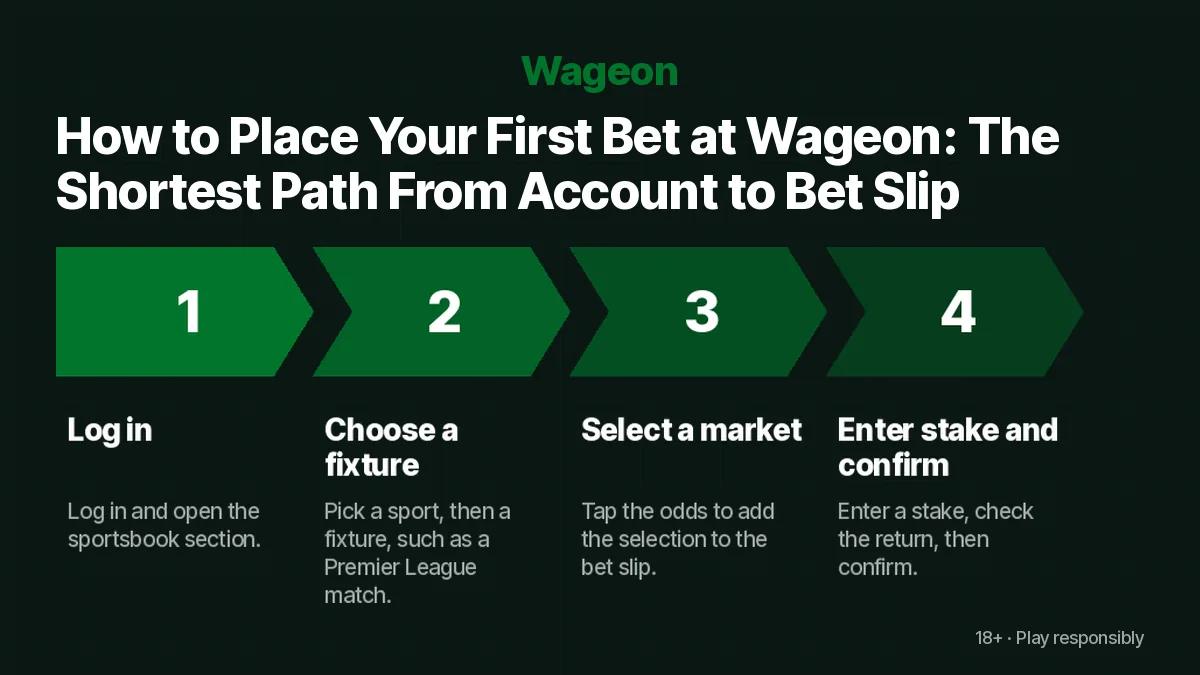
Wageon betting is a sportsbook offering for players in Great Britain, and the quickest route to a first bet is short. I open the sportsbook, pick a market, add one selection to the slip, enter a stake and confirm. Everything else is optional detail.
Here is the sequence I follow on wageon:
1. Log in and open the sportsbook section.
2. Choose a sport, then a fixture, for example a Premier League match.
3. Select a market and tap the odds to add the selection to the bet slip.
4. Enter a stake I am comfortable losing.
5. Check the potential return shown on the slip, then confirm the bet.
I keep my first stake small. Betting is entertainment with a real chance of losing, and I would set a deposit limit before the first wager rather than after.
Two Checks I Make Before Staking Anything
First, I scroll to the site footer and read the licence line. Wageon is presented as licensed by the UK Gambling Commission for the United Kingdom, and the footer is where the operator shows the licence details, so that is where I confirm it. Second, I check my KYC status. Identity verification is a standard requirement, and I prefer to finish it before depositing so a later withdrawal is not held up. I also look for the SSL padlock in the browser, and I remember that RNG-based games are separate from sports betting, where results come from real events.
Reading Wageon Odds: Formats, Implied Probability and Margin
Odds show the price of a selection, and I convert every price to implied probability before staking. For decimal odds, I divide 1 by the odds. For fractional odds, I divide the second number by the sum of both. The figures below are illustrative, not Wageon prices.
| Fractional | Decimal | Implied probability |
| 1/1 | 2.00 | 50% |
| 2/1 | 3.00 | 33.3% |
| 5/2 | 3.50 | 28.6% |
| 4/6 | 1.67 | 60% |
A worked example: at 3.00, a 10 pound stake returns 30 pounds including the stake, so 20 pounds profit. The implied probability is 33.3%, meaning the price assumes roughly a one in three chance.
Margin is the next check. In a Premier League match with three outcomes, I convert all three prices to implied probabilities and add them up. If the total is above 100%, the excess is the bookmaker's margin. A lower total generally means a fairer price for me, though it says nothing about who wins.
This matters across the board. A sportsbook sets its own prices and builds in margin. A betting exchange works differently, because I back or lay against other users and a commission applies instead. Spread betting is different again, since returns depend on how far the result lands from the quoted spread, and losses can exceed the initial stake. I only use it if I fully understand that risk.
For horse racing, such as the Grand National or Cheltenham Festival, I apply the same conversion to every runner. Odds are an estimate of chance, never a promise, and I only stake money I can afford to lose. Gambling is for adults aged 18+.
Bet Types Compared: Single, Accumulator, Each-Way and Bet Builder
I would start with singles: one selection, one outcome, and a loss that is limited to the stake. Accumulators, each-way bets and bet builders add moving parts, and each one changes the risk. Which of these appear on the Wageon sportsbook is something I confirm on the bet slip.
| Bet type | How it works | Risk level | Suits |
| Single | One selection, one result | Lower | Beginners learning how odds work |
| Accumulator | Several selections combined; all must win | Higher | Players who accept that one losing leg ends the bet |
| Each-way | Two bets: one on the win, one on a place | Medium | Longer-priced runners in horse racing |
| Bet builder | Several markets from one match combined | Higher | Players who want a custom Premier League bet |
Here is why I prefer singles first. With an accumulator, the combined odds look attractive, but every added leg lowers the chance that the whole bet wins. One missed leg loses everything.
An each-way bet doubles the stake, because it is two bets. A 5 pound each way bet costs 10 pounds: 5 pounds on the win and 5 pounds on the place. It comes up often with the Grand National and the Cheltenham Festival, where fields are large and prices vary widely. The place terms differ by race, so I read them before confirming.
A bet builder combines markets from the same fixture, so the outcomes are often linked. That can change the real chance in ways that are hard to judge, so I keep stakes small.
Beyond the sportsbook, a betting exchange and spread betting work on different principles, and I would not try either until I am comfortable with basic bets.
Funding and Cashing Out: Visa, Mastercard, PayPal and GBP
For GB players, Visa is the lead method I look at, with Mastercard and PayPal as alternatives, all in GBP. Before any wageon betting deposit, I open the cashier and read the method list, limits and processing notes there, because those details can change and I do not assume them.
| Method | Deposit | Withdrawal | Check in cashier |
| Visa | Listed as a funding method | Listed where supported | Limits, fees, processing time |
| Mastercard | Listed as a funding method | Listed where supported | Limits, fees, processing time |
| PayPal | Listed as a funding method | Listed where supported | Limits, fees, processing time |
I give no limits or payout times here, since the cashier is the only reliable source for them. What I do check is the currency: account balances and bets are in GBP, so I avoid any step that adds a conversion.
A general principle worth knowing is that withdrawals usually go back to the method used to deposit. This is common across the industry, so I do not treat it as a Wageon-specific rule, but I plan for it. If I fund the account with Visa, I expect to cash out toward the same card.
Before my first wageon betting withdrawal, I make sure my KYC verification is complete. Identity checks are a standard requirement, and finishing them early avoids delays when I want my money back.
I only deposit what I can afford to lose and set a deposit limit first.
Betting Offers and Wagering Terms: What to Read Before Opting In
Before opting into any betting offer, I read three things first: the wagering requirement, the minimum odds and the expiry. These terms decide whether an offer is worth taking, and I state no offer figures here because they change and belong in the current terms.
Wagering means the amount I must bet before bonus-related funds can be withdrawn. A wagering multiplier such as x40 means the bonus amount has to be staked that many times. I check which bets count, because many offers exclude low-odds selections, and a maximum stake rule can void winnings if I bet above it.
Any match offer requires a deposit, so I treat it as a decision about my own money rather than a free gift. If I would not make the deposit without the offer, I skip it.
For the current welcome terms, I read the wageon welcome bonus page. I search for a wageon betting welcome bonus only to find that page, not third-party listings, and I would be wary of any site claiming a wageon betting promo code that the official terms do not mention.
The same caution applies to a wageon betting no deposit bonus. If one exists, its terms will be on the offers page, and I would not assume it. Likewise, wageon betting free spins, where listed, are a casino-style reward with their own conditions, usually attached to the welcome bonus, so I read those separately.
Offers are marketing, not income.
Licence, KYC and Account Security: What I Verify Myself
I verify the licence myself rather than trust a claim. Wageon is presented as licensed by the UK Gambling Commission for players in the United Kingdom. I read the licence line in the site footer, then search the operator name on the UKGC public register and confirm it matches.
I give no licence number here, because the footer and the register are the sources to trust. Next, I check that the browser shows the HTTPS padlock, which indicates SSL encryption of the connection. For casino games, I know that RNG software decides outcomes, while sports results come from real events.
Behind the scenes, operators run AML checks to detect money laundering. I treat these as normal and expect questions about the source of funds if activity looks unusual. Offers and codes are a separate matter, and I check the wageon promo code page for current terms rather than third-party listings.
What KYC Asks For and Why It Delays Withdrawals
KYC is requested before a first withdrawal because the operator must confirm who I am and that I am an adult aged 18+. Typically that means photo ID and proof of address, and sometimes proof of the payment method. Delays usually come from blurry photos, expired documents or mismatched names. I upload clear, current documents early, before I deposit, so my first withdrawal is not held up.
Who Wageon Betting Does Not Suit and What Can Go Wrong
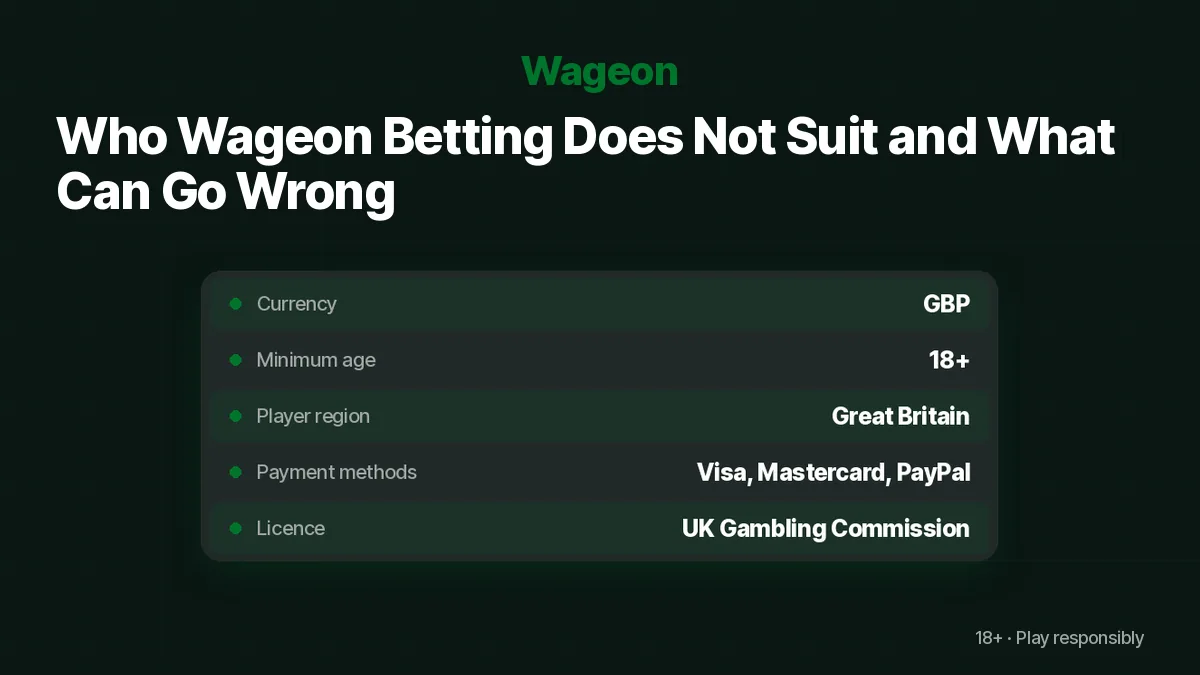
Wageon betting does not suit everyone, and I say so plainly. I would look elsewhere if I wanted guaranteed returns, if I were under 18, or if I could not afford to lose my stake. Betting is entertainment with real risk.
Here is where I would hesitate:
- Players who expect profit: no bet is safe, and losses are normal.
- Players who dislike identity checks: KYC and AML checks are standard and can delay a first withdrawal.
- Players who chase losses: this is the clearest warning sign for me.
- Players who skip terms: voided bets, suspended markets and unmet wagering requirements are the usual causes of disputes.
Common pitfalls are easy to check. A bet can be voided if an event is cancelled or a rule is broken. A market can be suspended during play, so a bet may not be accepted at the price I saw. Wagering left unmet can block a withdrawal of bonus-related funds. I read the terms for each before staking.
I do not cite wageon betting reviews or ratings here, since I have no verified figures to quote. If I read wageon betting reviews elsewhere, I treat them as opinions and check the facts myself.
My pre-deposit checklist:
1. Confirm the licence line in the footer and the SSL padlock.
2. Complete KYC verification.
3. Read the wagering, minimum odds and expiry terms of any offer.
4. Set a deposit limit I can afford.
5. Remember that RNG-based games are random and no pattern can be relied on.
Gambling is for adults aged 18+. If it stops being fun, I stop.
Staying in Control: Limits, GamCare and BeGambleAware
Responsible gambling starts before the first bet. I recommend every player does the same.
These are the tools I use and look for in the account settings:
- Deposit limits: a cap on how much I can add over a set period.
- Time-outs: a short break from betting when I feel I am losing focus.
- Self-exclusion: a longer block on my account if I need to step away fully.
I also keep to a budget I can afford to lose, and I never chase losses. Offers do not change that, and I read the terms of the wageon no deposit bonus page like any other promotion, without letting it push me to bet more.
If gambling stops being fun, independent help is available in the United Kingdom. GamCare offers free support and advice for anyone affected by gambling, and BeGambleAware provides information and guidance on safer play. Both are independent of any operator, and I would contact either one early rather than late.
FAQ
Is spread betting legal in the UK, and can I use it at Wageon?
Spread betting is legal in the UK and sits under UK Gambling Commission rules for gambling-style products. Whether Wageon offers it is something I confirm in the sportsbook menu or on the bet slip. Returns depend on how far the result lands from the quoted spread, and losses can exceed the initial stake, so I only use it if I fully understand that risk. Singles are the safer starting point. Gambling is for adults aged 18+.
How much does a 5 pound each way bet cost at Wageon?
A 5 pound each way bet costs 10 pounds in total, because it is two bets: 5 pounds on the win and 5 pounds on the place. The place terms differ by race, especially in big-field events such as the Grand National and the Cheltenham Festival, so I read them on the bet slip before confirming. The slip shows the total stake before I place the bet.
Is wagering the same as betting when I claim a Wageon offer?
Not quite. Betting is placing a stake on an outcome, while wagering is the total amount I must stake before bonus-related funds can be withdrawn. The welcome bonus carries a x40 wagering requirement, meaning the bonus amount has to be staked 40 times. I also check which bets count, the minimum odds and the expiry on the [wageon welcome bonus](/kz-stranica/bonus/) page before opting in.
Why can a first Wageon withdrawal take longer than expected?
The usual cause is incomplete KYC verification. Before a first withdrawal the operator must confirm my identity and that I am 18+, typically with photo ID, proof of address and sometimes proof of the payment method. Blurry photos, expired documents and mismatched names cause most delays. Extra AML checks can add time too. The trade-off is slower access to money in return for account security. I upload clear documents before depositing to avoid it.
Can I withdraw to a different method than the Visa card I deposited with?
Usually not. Across the industry, withdrawals go back to the method used to deposit, so if I fund my account with Visa I expect to cash out toward the same card. I do not treat this as a Wageon-specific rule, and the cashier shows which methods are available for withdrawal, along with limits and processing notes. Account balances are in GBP, so no currency conversion should be needed.